1. Open New tab and paste following code in your browser's URL bar:
data:text/html, <html contenteditable>
2. Hit enter and click on a blank page to take a quick note.
Tip: For quick access bookmark the page.
via Brandon Holtsclaw: quicknote
1. Open New tab and paste following code in your browser's URL bar:
data:text/html, <html contenteditable>
2. Hit enter and click on a blank page to take a quick note.
Tip: For quick access bookmark the page.


Let me tell you what: Will Riker knows how to put that ass to work, and Starfleet dress uniforms are a pink slip .
You may now spend some time thinking about Riker wearing an actual pink slip .
I’m positive that Fashion It So has come up in the comments here at least a couple of times, but it’s a consistently good time and a much better source of sartorial commentary than I will ever be (which, yes, this is like the Gobi Desert telling you that a river is a better source of commentary on things that are wet) and I love that they’ve put so much time and effort into it. And they just recently did the second Geordi-And-Leah-Brahms episode, which, oh my gosh, that red sweater, those yellow jumpsuits .

If you’ve ever tried riding your bike and using your phone at the same time, then you know how difficult it can be to focus on the road ahead. We use our bikes to get from point A to point B. We use our phones to connect, navigate, and document our lives. So why not make it easier to use our phones while we ride? The Handleband does just that.

The Handleband is made from a silicone band and a piece of aluminum that wrap around your bike frame to secure your device. It’s smaller than a deck of cards, but strong and durable at the same time. Whether you want to use it for some serious mountain biking or just to cruise down the block, it can handle whatever you got!

What makes the Handleband really interesting is that it solves a very simple problem that we all know so well. Stanford engineering student, Daniel Haarburger just made our lives a little bit easier. You don’t need an iPhone, or even a phone to use it! It’ll hold whatever you need – a hammer, a flashlight, anything!

Here’s the kicker: The aluminum piece that holds the silicone band in place doubles as a bottle opener! It’s a dream come true.

Go over to Kickstarter to pre-order. You won’t be disappointed.

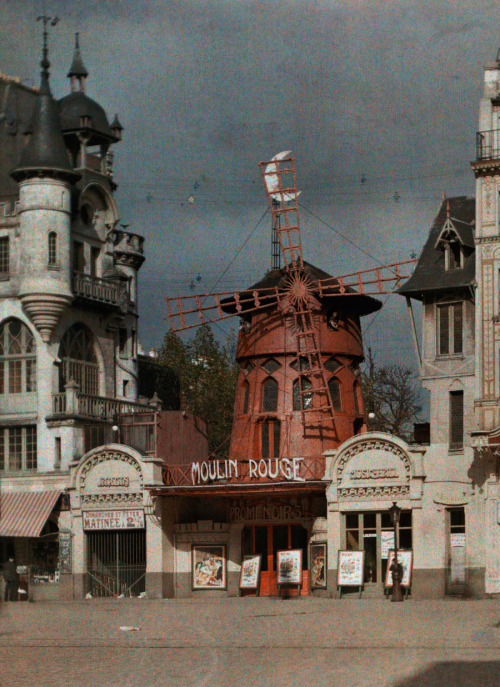
The Moulin Rouge at Montmartre in Paris, 1923.
Photograph by Jules Gervais Courtellemont, National Geographic

So that’s a still of TARDIS on fire from a trailer for the Doctor Who 50th anniversary. Luckily (for the TARDIS), the trailer is fan-made and fake, but it’s astonishingly well done and only makes us want the 50th anniversary episode now now now . You can see the trailer at the bottom of the post.
Your Morning Roundup is reading only the last sentence in every chapter of Greg Cox’s Man of Steel novelizations and still getting the majority of the story.
[Zod saves]
This Month in Photo of the Day: Travel Photos
The fennec, or desert fox, is a canine mammal species of the genus Vulpes , which inhabits the Sahara Desert and Arabia. This is the smallest species of the family Canidae.
This photo and caption were submitted to the 2013 National Geographic Traveler Photo Contest . Have photos of your own travels you would like to submit? Enter today !
See our editors' picks »
Vote for your favorites »
Browse all entries »

For Release Friday, June 21, 2013
Citiwire.net
 Tactical urbanism is blossoming in the United States, bringing the opportunity to change how we look at our neighborhoods and cities, and most important, how we improve them.
In early June, on a high-traffic street in St. Paul, Minn., Andrew Howard and Team Better Block tried some tactical urbanism to help show people see just how cool the street could be.
They narrowed a busy part of East 7th Street in the Dayton’s Bluff neighborhood by closing a lane in each direction and putting in potted plants, trees and a bike rack.
Photo Credit: Sam Newberg
They painted in a temporary crosswalk in a spot where neighbors though one was needed.
Photo Credit: Sam Newberg
They set up a playground, art booths, food stands and even a piano in the street.
Photo Credit: Sam Newberg
They placed images and information in vacant storefront windows to help people imagine how that space could be used, especially if the street outside was more pleasant.
Tactical urbanism is a local, grassroots effort that takes a place with having high commercial vacancy and/or fast-moving traffic (and Dayton’s Bluff grapples with both problems) and installs temporary trees, crosswalks, bike lanes, sidewalk seating and temporary uses for vacant storefronts. Essentially, it’s an effort to inspire neighbors to take back their street, to imagine how great the neighborhood can be when people gather and have a little fun. It’s a fairly low-cost way to demonstrate, temporarily, the potential for long-term change.
The events are great, but how can they inspire long-term change?
In a number of ways. People of all ages who attend can leave with a different perspective on how public space can be used. They can get involved, perhaps, by hosting another event, attending a neighborhood meeting and taking part in long-range planning for the area. Or they could lobby public officials for permanent traffic calming or crosswalks.
Elected officials might attend and note what onerous or obsolete regulations might be changed, to allow safer streets or to make it easier to open small businesses. Maybe someone needing a space for a business would be inspired by seeing a use for a vacant space and decide to lease or buy a building. Holding the event in a public space and letting people touch, feel, hear, smell and experience the potential of that place can inspire more change than a hundred public meetings in an indoor community room.
Team Better Block’s co-founder, Andrew Howard, has learned much from tactical urbanism events, and he put that experience to use in St. Paul. His advice:
Other tactical urbanists, like Mike Lydon of The Street Plans Collaborative spoke recently to the Congress for the New Urbanism’s conference, CNU 21 in Salt Lake City. Lyndon emphasized how short-term tactical urbanism events can inspire long-term changes or can catalyze plans that have been languishing.
Lydon pointed to a 1969 plan for pedestrian improvements on Broadway in New York City. They sat on a shelf until 2009, when a tactical urbanism event closed the street in Times Square so people could bring folding chairs and hang out. The result: permanent changes to Broadway. That test run was needed, to let people experience how the street could be used.
Streetsblog founder (and occasional Citiwire author Aaron Naparstek was emphatic about tactical urbanism’s ability to make change. Elected officials at all levels don’t care so much about “chair bombing” as a tool, but they do care about the community it creates and the people who can spark change in their neighborhoods. Don’t downplay the political aspect of this, Naparstek implores. Most of all, Andrew Howard says, make sure it is fun. People love reclaiming their streets.
Photo Credit: Sam Newberg
Tactical urbanism has already made significant small-scale changes in many cities. But perhaps what I like most is its ability to let children play in the street. In and of itself, that is such a simple, elegant and wonderful thing to watch it makes me weep.
Having been to countless public planning meetings, I appreciate that tactical urbanism not only ignores “why?” in favor of “why not?” but that it shows you “Why not?” in a tangible way. Sure, a lot of work can be required to make long-term change in how we use our urban places, but tactical urbanism shows how simple the solution can be if we just do it. So bring it on. Why not?
Sam Newberg is a Twin Cities-based writer and real estate consultant who writes as Joe Urban. Reach him at sam@joe-urban.com . A version of this article first appeared at www.streets.mn .
Citiwire.net columns are not copyrighted and may be reproduced in print or electronically; please show authorship, credit Citiwire.net and send an electronic copy of usage to webmaster@citiwire.net .